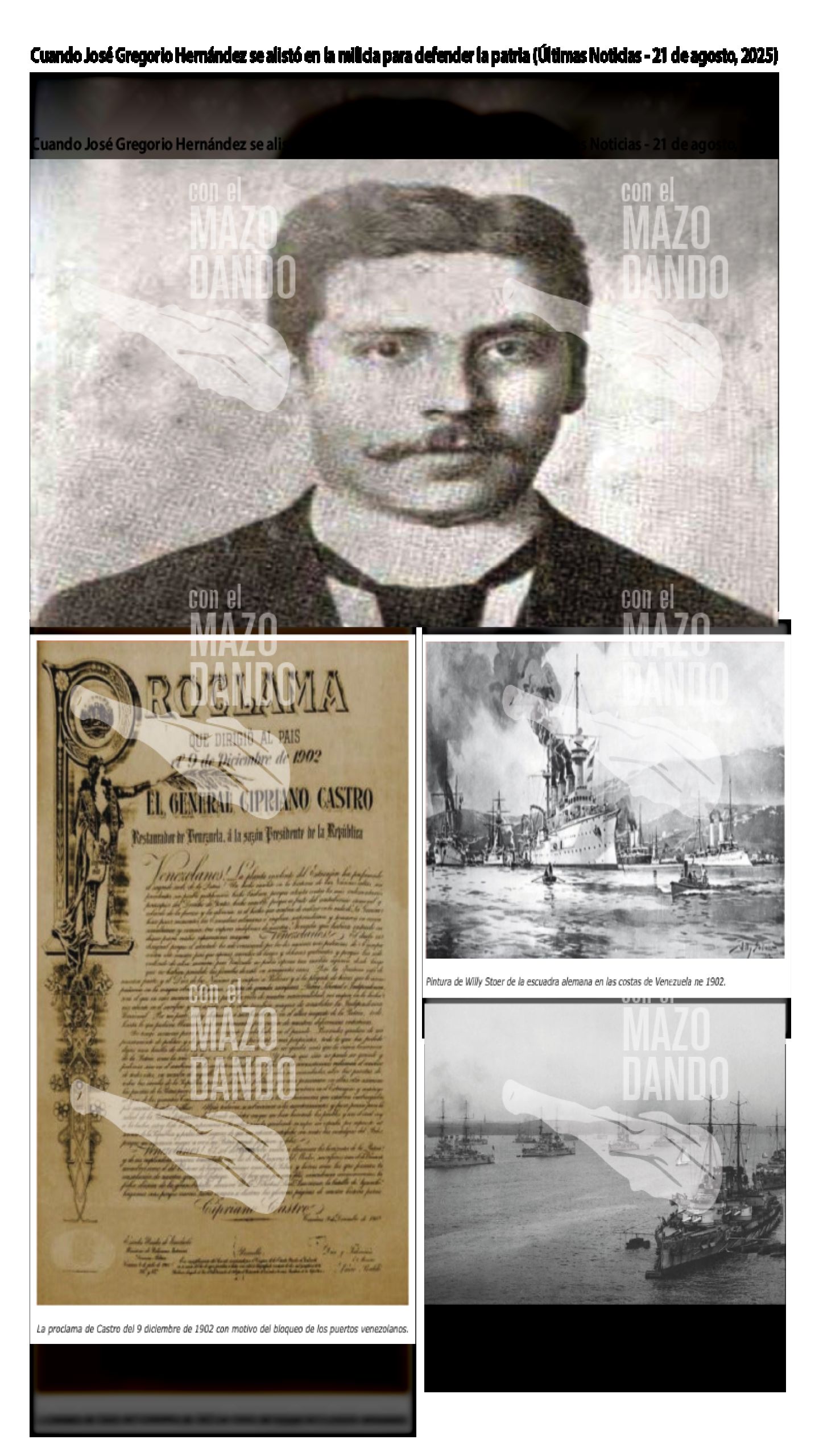
When José Gregorio Hernández joined the militia to defend the Homeland
Published at: 29/10/2025 09:00 PM
(Latest News Special, August 21, 2025)
He voluntarily registered with the militia of the parish of Altagracia on December 11, 1902, when Germany, the United Kingdom and Italy imposed a naval blockade on Venezuelan ports.
- The figure of José Gregorio Hernández (1864—1919) has been irreversibly engraved in the collective memory as the humanitarian doctor par excellence, the “doctor of the poor”. But rarely does another fascinating aspect of his life stand out: his brief but significant stint with the militia during the naval blockade of Venezuela of 1902—1903. His act of offering military service to the country brings a new dimension to the complexity of his commitment to the Homeland.
- In early December 1902, the powers of Germany, the United Kingdom and Italy imposed a naval blockade on the Venezuelan ports of La Guaira, Puerto Cabello and Maracaibo to demand payment of debts claimed by foreign companies, in the midst of the so-called Liberation Revolution. They captured ships of the Creole navy and bombed the Puerto Cabello fort.
- President Cipriano Castro responded with a forceful proclamation: “The insolent plant from abroad has desecrated the sacred soil of the Fatherland!” , calling on the People to defend the nation. That message ignited the patriotic spirit of many Venezuelans, who would volunteer in popular militias.
- Dr. José Gregorio Hernández was living in Caracas when on December 11, 1902, he voluntarily joined the militia of the parish of Altagracia, according to the official ballot of the Militia Headquarters No. 1. This document indicates that he was 38 years old, single, lived on Calle Norte 2, house 36, and that he practiced as a doctor.
- Despite his deep pacifism and religious commitment, Hernández did not hesitate to respond to the nationalist call, a decision highlighted even by historians and contemporary media. According to one of his biographers, Miguel Yaber, Hernández was the “first to enlist” as proof of that patriotic fervor, although “thank God” the exchange of the stethoscope for the rifle did not take place.
- Beyond that brief episode as a militiaman, José Gregorio Hernández's life was characterized by an immense amount of work in science, teaching and charity. After graduating in 1888, he studied in Europe (Paris and Berlin) and became a pioneer of experimental medical teaching in Venezuela. He founded the chair of histology, experimental physiology and bacteriology at the Central University of Venezuela (UCV), introduced the use of the microscope and promoted modern scientific methods.
- His social vocation was exemplary: during the Spanish flu pandemic, in 1918, he was at the forefront of the fight as part of the National Aid Board. In addition, he was known for his acts of charity: he placed a “bag for the poor” outside his office so that those who could not afford to pay could help themselves without humiliation.
- A multifaceted symbol. This belated gesture of militarization —although symbolic and brief— in the context of the 1902 blockade does not contradict its pacifist identity, but rather complements it. It shows that their commitment was not limited to healing the body in times of illness or poverty, but that it also contemplated the defense of national sovereignty when faced with foreign aggression.
- In short, José Gregorio Hernández emerged as an integral citizen: a scientist, humanitarian, religious and, for a moment, a volunteer militiaman. His enlistment in 1902 shows that he was willing to “defend the Fatherland”, even temporarily renouncing his medical vocation if the situation was pressing.
Mazo News Team