Published at: 04/12/2024 10:00 PM
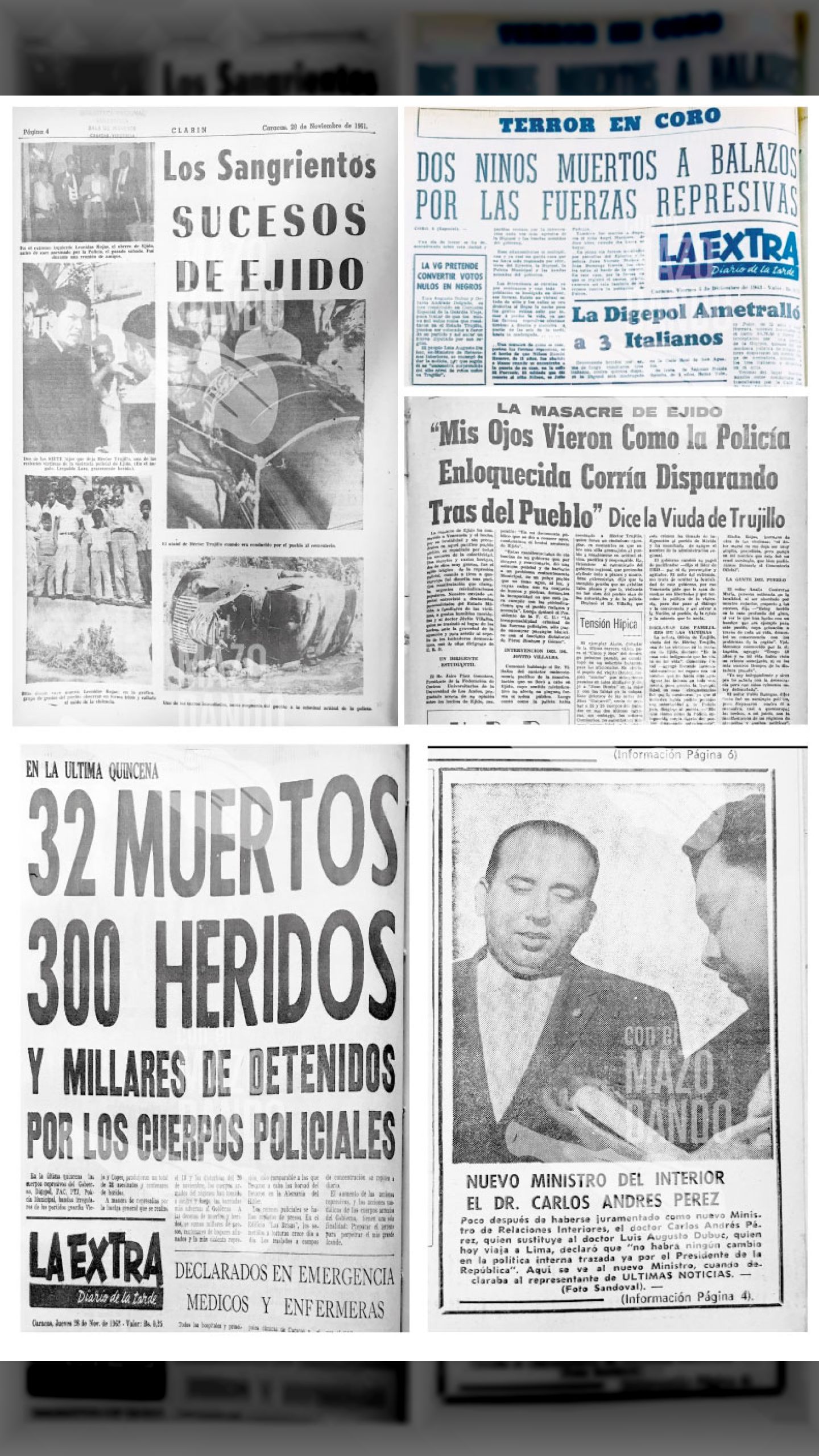
(LA EXTRA, November 23 to December 16, 1963)
- The absence of a historical perception of what was happening in Venezuela and a political myopia, which closed the horizon to progressive actors adverse to the government of Rómulo Betancourt, prevented the unity of social forces, competing on a single front, to defeat a government whose candidate, Raúl Leoni, in the general elections of 1963, had every chance to lose.
- Betancourt's last repressive onslaught (November-December 1963) demonstrated his desperation and detachment from all democratic principles. To impose Leoni, he didn't mind taking the lives of children, the elderly, peasants, women and political leaders who fell under the gusts of their police and paramilitary forces. Among them:
- November 27, in Ejido, edo. Mérida, two people were shot down by the Municipal Police; one of them was Professor Héctor Trujillo, who was killed at a time when he spoke on a chair to the crowded crowd that peacefully expressed their discomfort over government abuses.
- On November 22, in Cabudare, edo. Lara, the young leader of Ad-Opposition (PRIN — Republican Party for Nationalist Integration), Nabor Díaz, 19, was shot in the back by a Digepol agent, when the student didn't answer his voice out loud.
- On December 5, two children were killed in the city of Coro, edo. Falcon. A wave of terror unleashed on this city and neighboring towns by the increasingly aggressive intervention of Digepol, together with armed government gangs, claimed the lives of 13-year-old Nelson Ramón Romero, who was shot to death outside his house on Porvenir Street, in addition to the 12-year-old Ángel Martínez boy, on his way home.
- That same day, in the middle of the road in the city of Coro, Juan Vicente Molina and Iván Domingo García were hit by a police patrol, who died as a result of injuries caused.
- Weeks ago, in Punto Fijo, edo. Falcón, two young men: Freddy José Medina and Cruz Manuel Marval Reyes, were machine-gunned down by Digepol agents, including AD leaders and employees of the Creole Petroleum Corporation payroll.
- On December 10, a thousand soldiers arrived in rural areas of Falcón state, with orders to occupy everything and leave “the scorched earth”, without worrying about the fields or the lives of the peasants, some of whom were shot because they were considered “collaborators” of the guerrillas.
- That same day, in Caracas, with machine gun fire, a National Guard killed the unfortunate worker Clara Luisa Marcano, inside a nightclub located on Sucre Avenue.
- On December 14, the 16-year-old student, José Inés García, was shot to death in the stomach while he was inside his home on Calle El Carmen, No. 4 of the Antímano Parish. The shooting was fired by the Municipal Police agent, Teodoro Hernández.
- On November 24, in San Juan Parish, a policeman dressed in civilian clothes took the lives of: Pedro Martínez, 24, and Félix Jacinto Sosa García, 19.
- In Caracas, the fierce repression of Digepol, the National Guard, the PTJ and the Municipal Police against the civilian population left numerous casualties. The partial list of gunshot wounds admitted to health centers was as follows:
- Ana Jacinta González (11 years old), Pilar Zaraza (30 years old), Gustavo Fernández (14 years old), Rafael Guzmán (33 years old), Pedro Eliseo Freites (44 years old), Erasmo Alcalá Castillo (20 years old), Juan Bautista Díaz (24 years old), Santos del Carmen Marcano García (38 years old), Bonifacio Hugas (27 years old), Eladio Abache (27 years old), Ezequiel Olivero (25 years old), Daniel Ribas Mendoza (17 years old), Felix David Moreno, among others.
- These are just some of the dozens of victims who fell during the repressive wave promoted by President Betancourt, in November and December 1963, with the intention of increasing abstention, intimidating protests and pacifying the discontent that exists throughout Venezuela because of his criminal management at the head of the government.
Mazo News Team