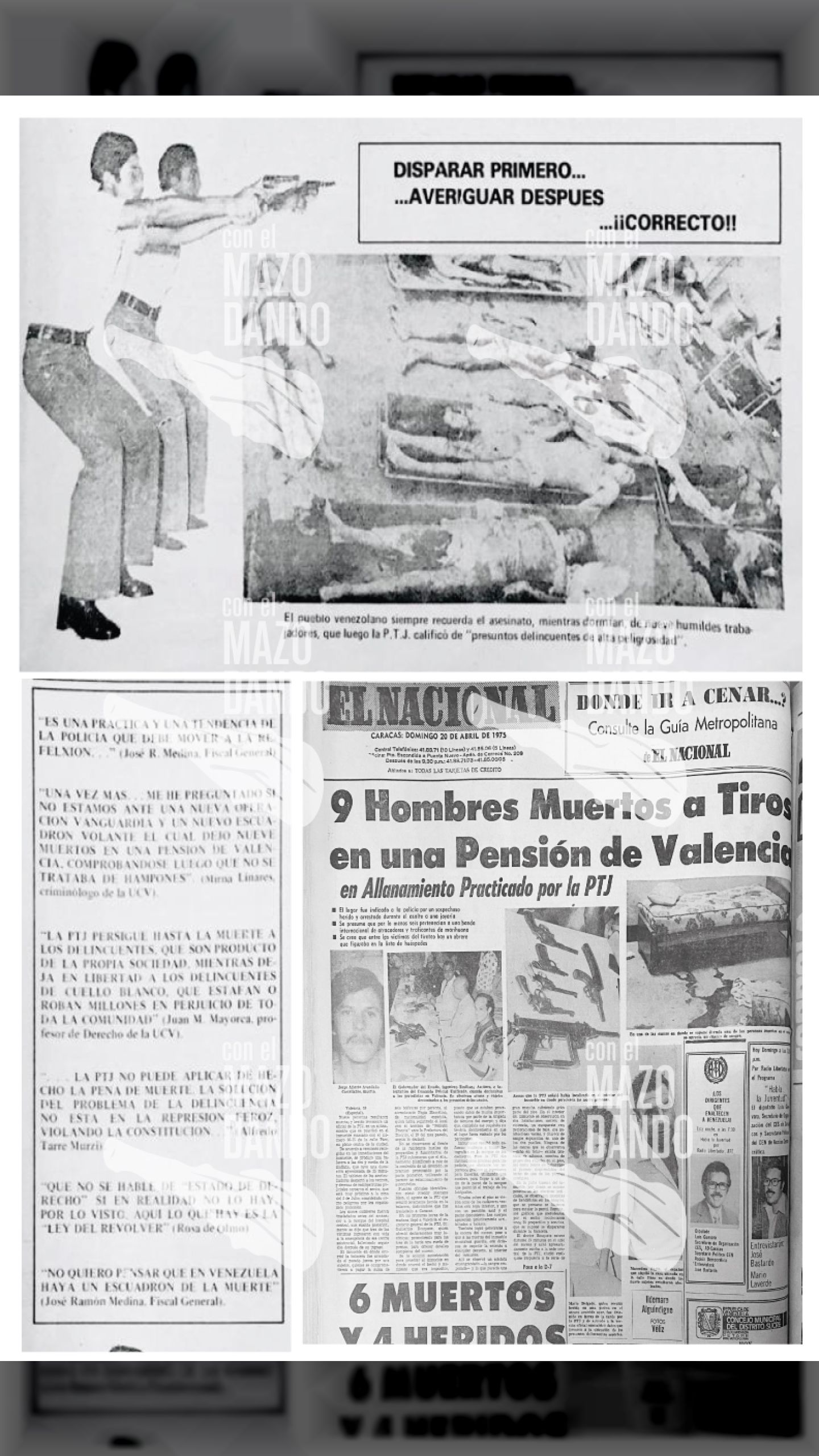
THE VALENCIA MASSACRE
Published at: 23/04/2025 08:00 PM
(EL NACIONAL, APRIL 20, 1975)
- During the first administration of Carlos Andrés Pérez (1974-1975), the Operational Tactical Support Group (GATO) was created, which blinded the lives of many innocent people in Venezuela.
- At 2 in the morning, on April 19, 1975, a search took place, without a court order, in a central pension located at 96-35 Páez Street near the 5 de Julio neighborhood of the city of Valencia, edo. Carabobo.
- There, the officials of the GATO Group entered the room where several workers were staying, killing nine of them.
- This became, to that date, the police assault with the highest number of innocent people killed in the country's history.
- The so-called Valencia Massacre caused a national shock, since at first it had been said that the deceased were criminals. However, they all turned out to be unarmed and killed in their sleep. It was later determined that they were not thugs (El Nacional, 17-5-78).
- It was found that those executed were shot to the soles of their feet and hands, so it can be deduced that the pensioners were lying down.
- Initially, the government said that all those executed were undocumented Colombian nationals. Since the identification of the bodies cannot be known. Strangely enough, all their data disappeared from the archives of the National Directorate of Foreigners (DIEX). Later, the necrodactyly system yielded information on five of the unfortunate workers.
- These alleged criminals, who were extremely dangerous, turned out to be nine humble people who shared a room in a workers' pension.
- Once all the victims and their perpetrators were identified, the trial of the nine massacred workers rotated from court to court, until five years later, he settled in Caracas, along with the file of the famous Carmona case, because several of the detectives involved were also tried for the murder of the criminal lawyer Trujillo.
- The application of the illegal death penalty, during the governments of the Fourth Republic, was a practice inherited by the successors of Rómulo Betancourt and that persisted until the repeal of the Constitution of 1961, and the entry into force of the current Bolivarian Constitution of 1999.
Mazo News Team