Published at: 26/11/2025 09:00 PM
(El Mundo, November 22, 1991)
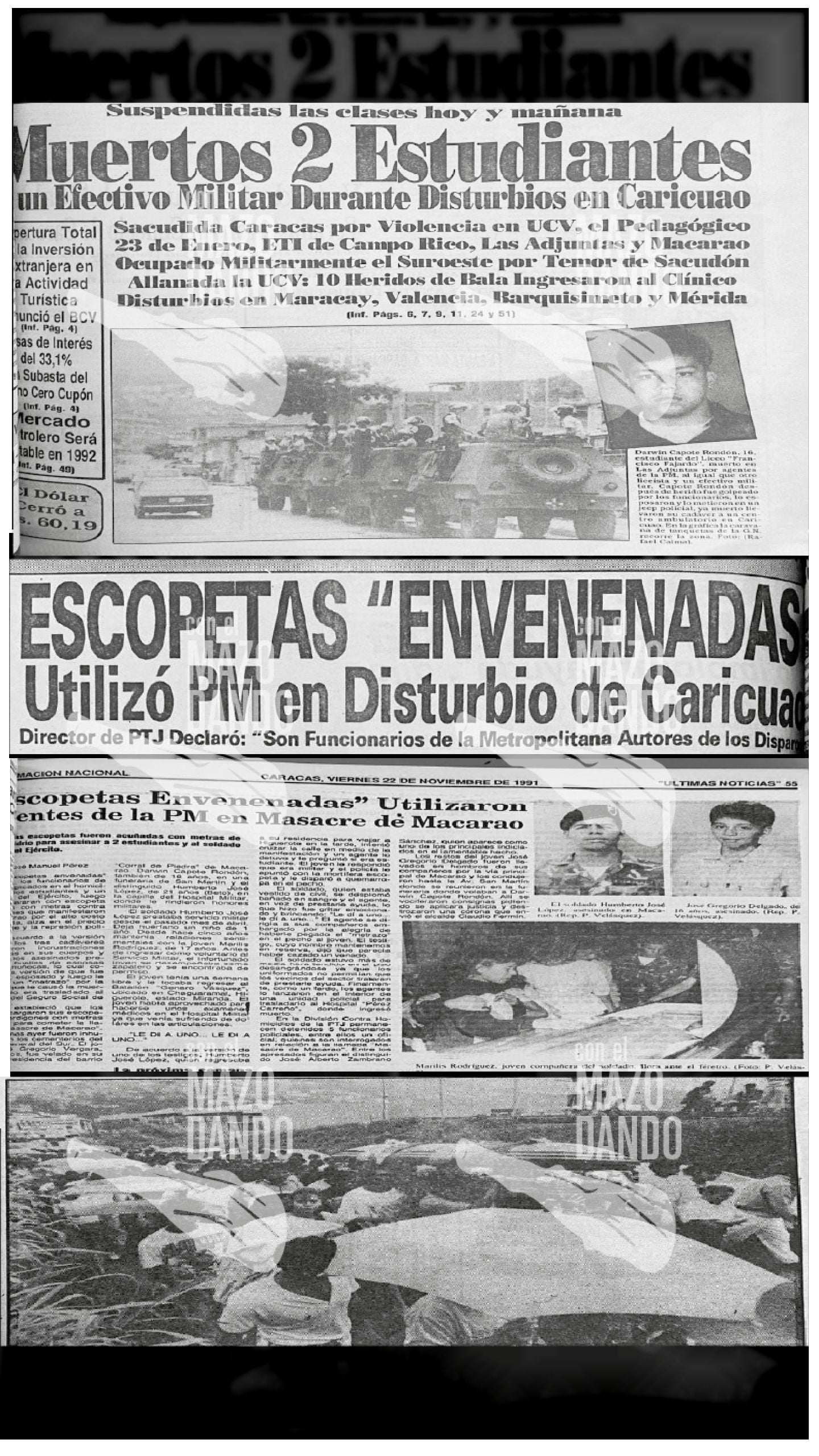
- 34 years ago, during the celebration of Student Day week, thousands of high school students took to the streets to protest the de facto elimination of half a student passage.
- In the context of the police repression, implemented by the government to stop marches and protests, students Darwin Capote and José Gregorio Vergara, both 17 years old, were killed in Macarao by Metropolitan Police (PM) agents.
- A third victim, Army soldier José Humberto López Arias, 21, was also massacred by government lead when he tried to intervene to prevent the massacre of the two young men.
- The murdered high school students had come out to demonstrate chanting slogans to vindicate half a student pass, an acquired right that the government did not enforce, inculcating, incidentally, the practice of police hatred against the demonstrators, within the ranks of the State's repressive bodies.
- The three victims were shot down with “poisoned shotguns”. This tendency to police brutality against students was frequently manifested when police officers emptied the contents of plastic pellets, to replace them with spark plugs, screws or nails.
- This lethal practice blinded the lives of 50 students, during the four years that CAP ruled Venezuela for the second time.
- That same month, during the week of Student Day, eight high school students were murdered in several cities of the country, including:
- Ricardo Silva, 17, who was hit by a bullet during the riots at the University of Carabobo (UC), in Bárbula.
- Rubén Darío Cárdenas, from the University of Los Andes (ULA), in Trujillo, who bled to death from a femoral vein wound while fleeing from the police.
- Jimmy Hernández, a student at the Andrés Bello High School in Caracas, who died while demonstrating against CAP's plan to privatize free public education.
- This wave of protests rose across the country, not only to claim middle class student rights, but to stop the privatization boom of the government that fraudulently bankrupted several creditworthy State companies and then sold them off at ridiculous prices, such as: sugar mills, hotel chains, cement plants, shipyards, shipping companies, thermoelectric plants, Viasa, Aeropostal and CANTV, among others.
- The next companies on the looting list were the state oil company PDVSA, the basic industries of the Venezuelan Corporation of Guiana (CVG), Hidrocapital, regional hydrological companies, highways, cable cars and the Compañía Anónima Metro de Caracas.
- All of the above contributed to strengthening the mechanisms of the poverty factory, installed since 1958, which ruined Venezuela, contributing to higher rates of unemployment, school dropout, malnutrition, infant mortality, inadequate health, poor housing, social violence, abandoned childhood, begging (extreme poverty), food shortages, paralysis of agricultural production, depopulated fields, urban overcrowding and the abysmal widening of social divides.
Mazo News Team