
THE DISPOSSESSION OF THE ESEQUIBO WAS FORGED BETWEEN THREATS AND TRAPS THE INVALIDITY OF THE PARIS ARBITRATION AWARD
Published at: 13/05/2026 08:23 PM
(The Truth, October 13, 1965 and Memories of Venezuela, No. 34, January-February 2016)
- 126 years ago, on October 3, 1899, an arbitral tribunal based in Paris ruled that the Cajón del Essequibo, with a dimension of 159,000 square kilometers, whose legitimate, peaceful and lasting possession for more than 300 years was exercised by the General Captaincy of Venezuela in accordance with the ancient principle of International Law Uti Possidetis Iure *, belonged to the United Kingdom.
- All this in contradiction with the public and notorious recognition that, in 1825, England made to the Republic of Gran Colombia from its borders with the Essequibo River and with the Anglo-Dutch Treaty of 1814, through which it only acquired 37,000 square kilometers from the Netherlands for an amount of 3 million pounds sterling.
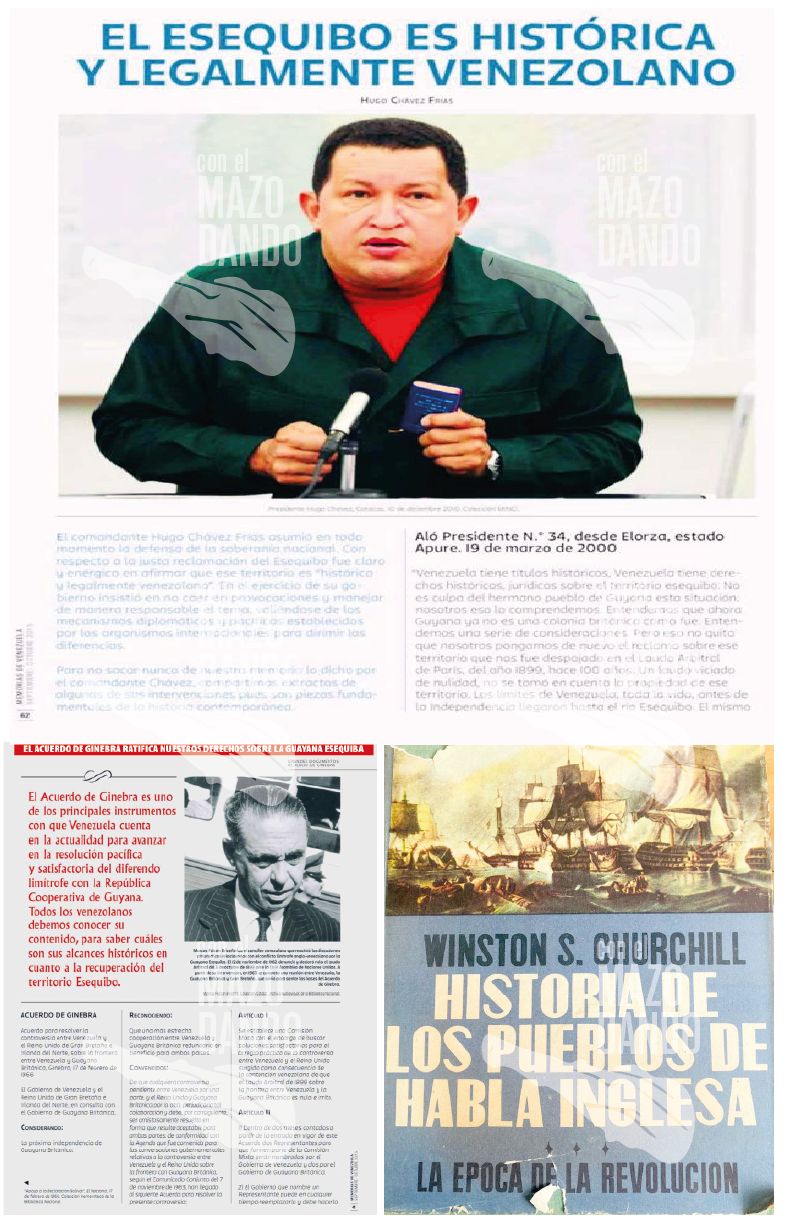
- In his work “History of the English-Speaking Peoples” the British Prime Minister, Winston Churchill, outlined the colonial division in the following terms: “The British were mainly affected when it came to the colonial settlement... The captured French colonies were returned... The Dutch regained their possessions of the East Indies (Indonesia)... the rich island of Java returned to their former owners... and for the price of three million pounds they acquired a part of Guiana from the Dutch.”
- Acquisition that borders the Essequibo River, as far as it delimited Dutch Guiana, not beyond. Therefore, the Paris Arbitration ruling of 1899 perpetrated the greatest territorial plunder recorded in the annals of universal history.
- First of all, the main anomaly consisted in granting England a much larger extension than that established in cars, falling into the habit of Ultra Petita. Secondly, he rejected the presence of the Venezuelan delegation during the two years of the sessions that determined that the plundered territory be allocated to England; finally, maps and documents were forged and hidden in the British archives, which to date have not been reviewed by Venezuela or by international courts.
- Therefore, this judgment is vitiated by absolute nullity in the formal aspects, as well as in the fundamental matter, of an award that was the subject of genuine procedural fraud, both substantive and formal.
- The complaint, as such, was subject to the will of a single biased arbitrator in favor of England, who imposed a procedure in the absence of Venezuela, under the representation of an equally biased third party, the United States of America.
- Without the presence of Venezuela, the American and English referees appointed Russian lawyer Frederick De Martens as an arbitrator of equity and law.
- De Martens openly threatened, at the negotiating table, with the English invasion of Venezuelan territory, to carry out the de facto annexation of Upata to the banks of the Caroní River.
- Another argument, which vitiates the Paris Arbitration Award of 1899 of absolute nullity, is that, in 1834, England, once Gran Colombia was dissolved, officially recognized Venezuela as an independent republic in the concert of nations, admitting that our territories are those of the former Captaincy General of Venezuela. Therefore, the boundaries of the then British Guiana are due to this full-fledged recognition of Venezuelan territory.
- In fact, later, the American jurist Severo Mallet-Provost, appointed as Secretary of the Paris Arbitral Tribunal, revealed that “Great Britain was granted territory over which it has not the slightest shadow of law”.
- In fact, Severo Mallet-Prevost, in a posthumous letter published in 1948, revealed how the referee Federico De Martens forced the decision in favor of Great Britain and threatened to grant more territory to the English if they did not join a unanimous decision, or by consensus, to strip Venezuela of these lands.
- As a backdrop, there has always been a British desire to extend its borders to the Yuruari region, where huge deposits of gold and diamonds have been known to exist since 1740. Venezuela was, in fact, one of the world's leading gold producers (1870-1910) until production declined due to the oil boom.
*The uti oposidettis iure, from Latin “as you possess according to the law”, is a principle of international law that establishes that new States that have emerged from a process of independence or decolonization will maintain the same borders that they had as colonial administrative divisions at the time of their independence.
Mazo News Team