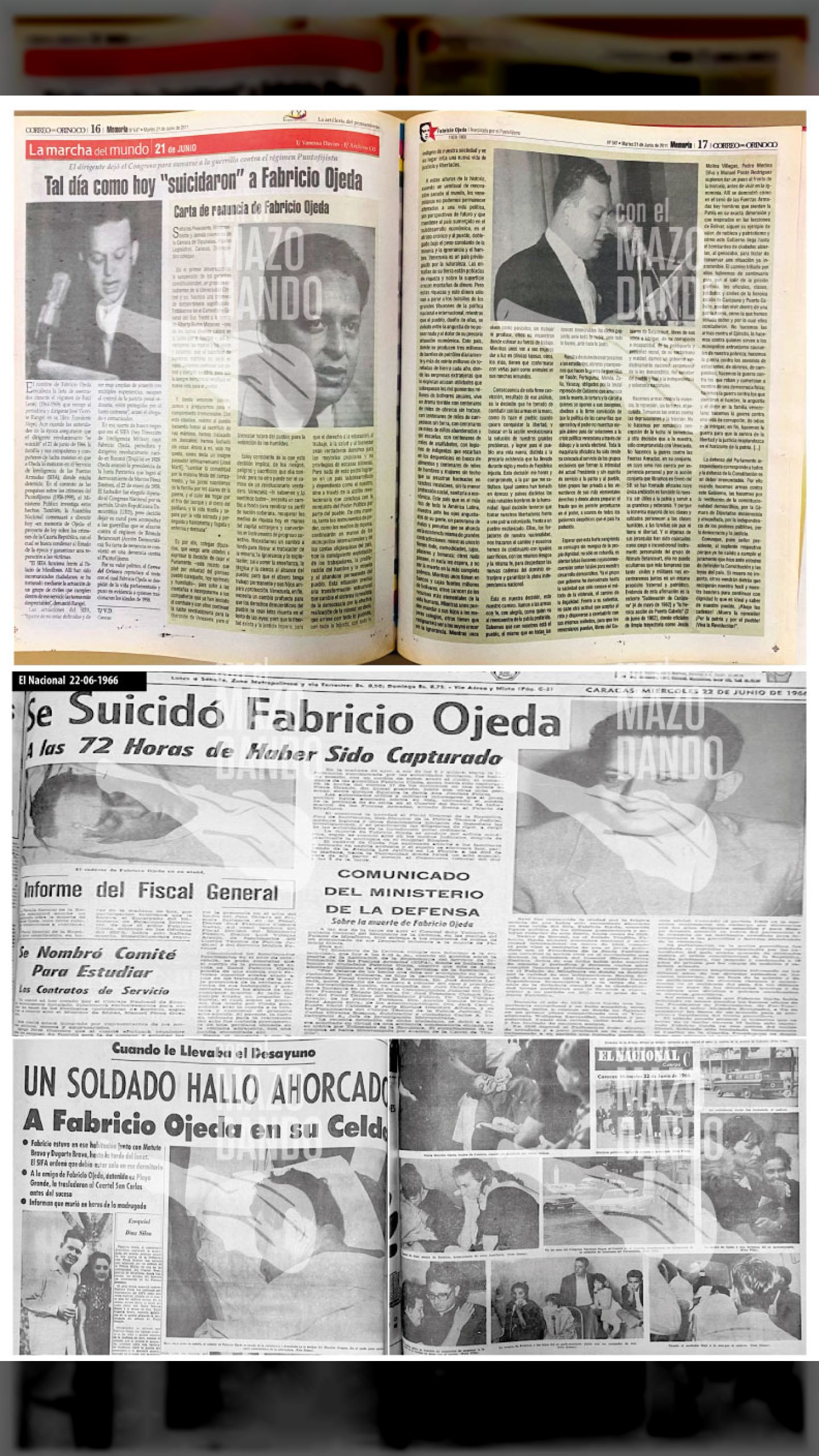
THE DEATH OF FABRICIO OJEDA ACCUSES LEONI'S GOVERNMENT
Published at: 25/06/2025 09:00 PM
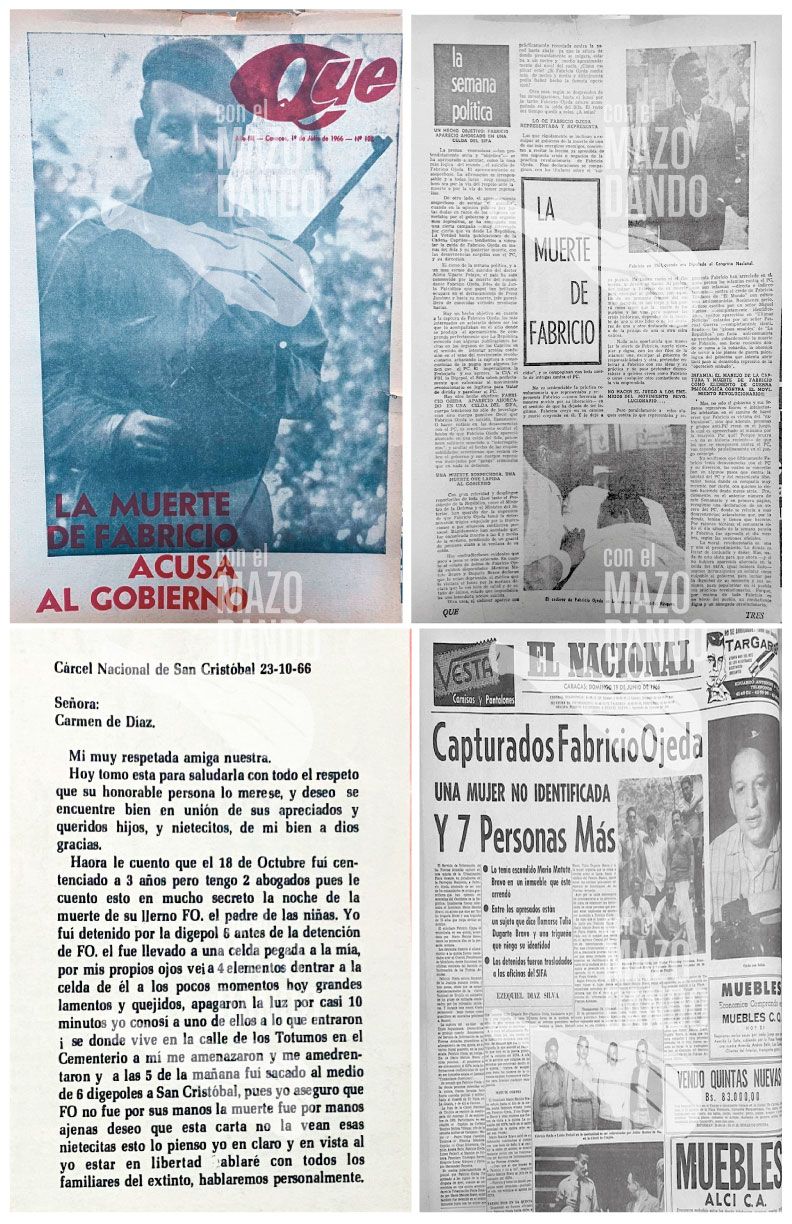
(What, July 1, 1966; El Nacional, June 22, 1966 and Correo del Orinoco, June 21, 2011)
- Fabricio Ojeda was hanged, on the morning of June 21, 1966, at the headquarters of the Armed Forces Intelligence Service (SIFA), just 50 meters from the Miraflores Palace.
- In the SIFA cells, several political leaders who opposed the governments of Rómulo Betancourt and Raúl Leoni were arrested, held incommunicado, tortured, murdered and disappeared.
- Upon hearing the news about the alleged suicide of Fabricio Ojeda, José Vicente Rangel reported:
- “There is an objective fact: Fabricio Ojeda was hanged in a cell of the SIFA, a dark police force, not only an investigative body, but also a punitive body.”
- “The SIFA operates in front of the Miraflores Palace. Citizens have been held incommunicado there, tortured by a group of civilians who carry out, within the service, the most despicable tasks”.
- Fabricio Ojeda died as a prisoner, isolated, subjected to “interrogations” (torture), trying to hide the fact of the very severe responsibilities that fell on the government and its repressive agencies, managed by “gangs” of criminals who stopped at nothing.
- A witness to the murder of Fabricio Ojeda wrote, from the San Cristóbal National Jail, a letter addressed to his relatives, dated 23-10-66 and published in the weekly RUPTURA, in June 1976, in which the following statement read:
- “I was arrested by DIGEPOL 6 days before Fabricio Ojeda, he was taken to a cell next to mine, through my own eyes I saw four elements enter his cell, after a few moments I heard big cries and moans, they turned off the light for almost 10 minutes... I assure you that Fabricio Ojeda was not death by his hands, it was by the hands of others... I was threatened and frightened and at 5 in the morning I was taken out in the middle of 6 digepoles (to prison) de) San Cristóbal...”
CONTEXT:
- There is a telegram sent by the Ministry of Defense of Venezuela to the Pentagon, revealed in the No. 1 edition of the magazine Casa de las Américas, which reads as follows: “President Leoni recommends that the Bolivian government spread the news that Che Guevara -captured alive- would have committed suicide -stop- and offers to send to La Paz Digepol expert in manufacturing prisoner guerrilla suicide —stop— the same expert who dealt with the Fabricio Ojeda case —stop-”.
- In the magazine LIFE, dated June 10, 1961, with Fabricio Ojeda being the elected deputy to the National Congress with the highest number of votes, an article was published entirely dedicated to his profile as a revolutionary politician, in which he was described, together with Fidel Castro, as “one of the most dangerous politicians in the Latin American hemisphere”.
- On January 1, 1960, the first anniversary of the Cuban Revolution, Fabricio Ojeda was a guest of honor.
- In the company of Fidel Castro, they paid a visit to the Sierra Maestra and at Pico Turquino he was awarded the rank of Lieutenant in the Cuban Revolutionary Army.
- To date, Fabricio Ojeda and Ernesto “Che” Guevara were the only two foreigners to whom military ranks had been conferred within the Cuban Revolutionary Army. Che was on the verge of coming to Venezuela many times to join Fabricio Ojeda in the guerrilla struggle. It was the envy of some left-wing pseudomilitants, who objected to this magnificent attempt.
- Fabricio Ojeda traveled extensively throughout Latin America, the Soviet Union, China and Europe, and was already an international leader. Thus strengthening ties of solidarity and friendship with social forces of international power, with its newly founded Revolutionary Party of Venezuela.
- Fabricio was born in Boconó, Edo. Trujillo, January 6, 1929. He was a writer, journalist, politician and active social fighter who contributed, with his great efforts, to the fall of General Marcos Pérez Jiménez. In fact, during this period he was the prominent journalist in Miraflores who covered all the president's acts and in turn was the president, in hiding, of the Revolutionary Patriotic Junta.
- In December 1958, Fabricio Ojeda was elected deputy to the National Congress by the Democratic Republican Union (URD) party. He was the most voted parliamentarian at the national level representing the voters of the Federal District-Caracas.
- On June 30, 1962, seeing the aspirations of the People frustrated and betrayed the revolutionary spirit that shook Venezuela on January 23, 1958, he wrote his legendary letter of resignation from Congress, which is nothing more than an echo of popular indignation at the massacres, persecution and selective assassinations committed by the government of Rómulo Betancourt.
- Later, he joined as commander of the José Antonio Páez Guerrilla Front of the Armed Forces of National Liberation (FALN), created by young soldiers and former militants from AD, URD and PCV to overthrow Betancourt.
Mazo News Team