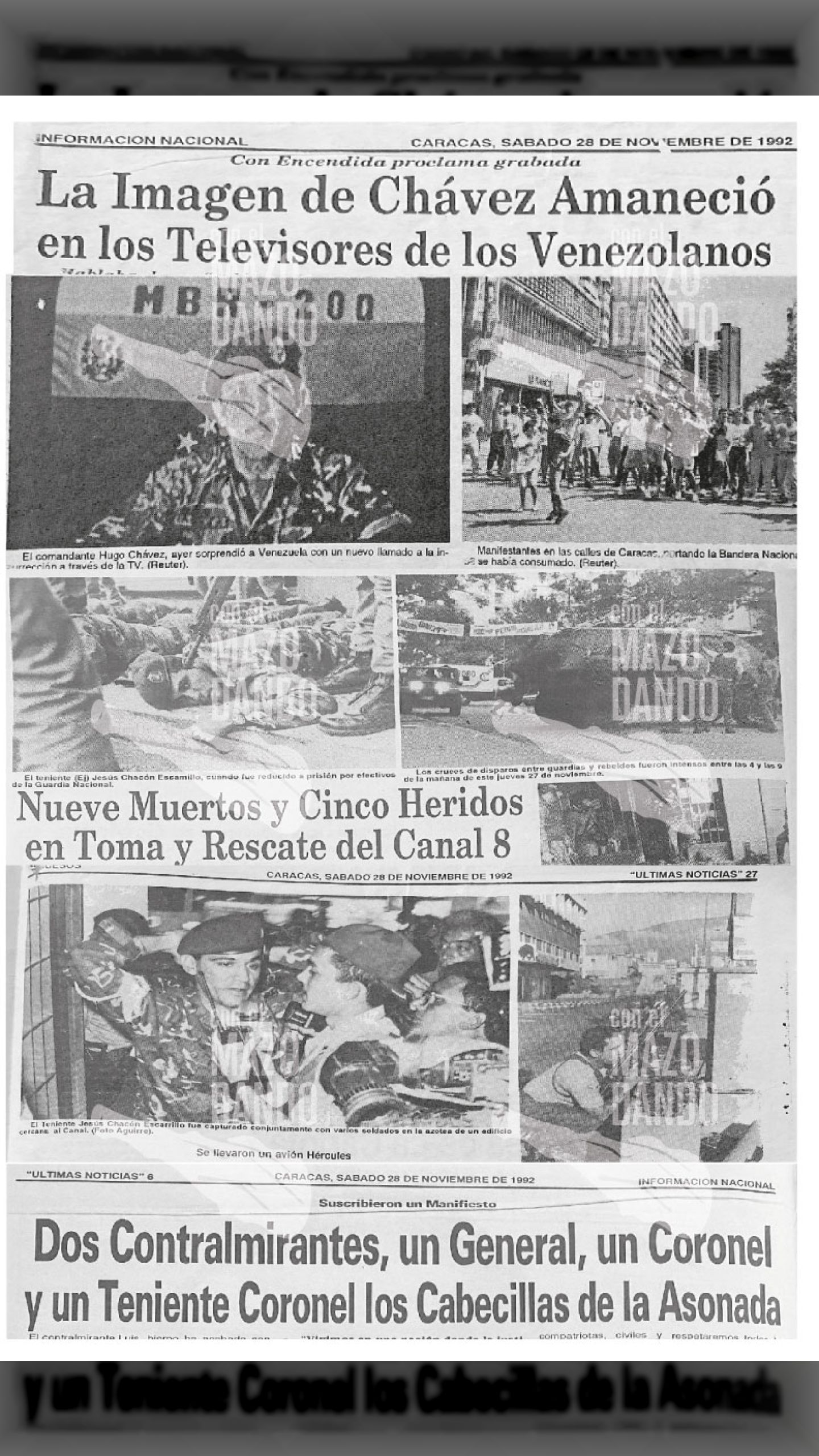
The 27-N THE MBR-200 SURGES FOR THE SECOND TIME
Published at: 27/11/2024 10:00 PM
(LATEST NEWS, November 28, 1992)
- In the midst of a political and social crisis never seen before in the history of Venezuela, combined with the collapse of the so-called “representative democracy”, in the early morning of Friday, November 27, 1992, the country witnessed the second historical phenomenon that checkmated the government of Carlos Andrés Pérez and his prescriptions of the International Monetary Fund (IMF).
- Starting early in the morning, Commander Hugo Chávez's speech went around the world transmitting a proclamation for the formation of a revolutionary government of national emergency, requesting support for the Patriotic Junta of the MBR-200 and making way for the convening of general elections within the framework of respect for constitutional guarantees.
- The entire Venezuelan people woke up to the voice and image of Commander Chávez broadcast on three television channels and the radio station Radio Rumbos, where he urged them to take to the streets and join the ongoing Revolution.
- The EFE agency reported: “Colonel Hugo Chávez issued a proclamation asking troops loyal to the government to join him and put an end to the last vestiges of this government. The civilians who appeared on the screen said that this movement spreads across the country and is led by soldiers of the Bolivarian Revolutionary Movement 200 (MBR-200) led by Hugo Chávez.”
- All of this happened while the sky over Caracas was the scene of Venezuela's first air battle, with the low flying of Bronco planes facing the fire superiority of F-16s loyal to the government. Unexpectedly, Commander Luis Reyes Reyes crossed the skies of Caracas in an F-16, breaking the sound barrier and thus telling history that they were rising up against the neoliberal policies and the economic package of Carlos Andrés Pérez.
- Última Noticias highlighted the graphic of the surrendered officer who directed the VTV takeover, Lt. Jesse Chacón Escamillo, with the tip of an FAL gun pointed at his face. In addition, he highlighted the statement issued by the naval officers who led the uprising: “The national crisis has reached its highest level of expression. There is not a human being in the country who does not feel hit by the effects of a brutal economic policy, socially marginalized and threatened in their physical integrity by the action of crime that advances like an uncontrollable tidal wave... We live in a nation where justice does not exist, where the rule of law has disappeared. A nation of obscene privileges and the dispossessed on the verge of a nightmare...”
- Radio Rumbos was violently raided by DISIP officials. They ripped out microphones, destroyed consoles and cut telephone lines. The station broadcast, under the baton of Teresa Maniglia, minute by minute, the incidents of November 27. Both she and her colleagues courageously continued to air for other studios, despite police brutality.
- The journalist, Virgilio Fernández, a reporter for El Universal, was killed by National Guard fire while covering the events that occurred at the La Carlota Air Base.
- Meanwhile, the army, under orders of Carlos Andrés Pérez, fired incessant bursts at the blocks of January 23 for hours.
- Inside and outside VTV, the government massacred surrendered civilians and soldiers, who had surrendered their weapons.
- Amid the confusion, the governor of Caracas, Antonio Ledezma, and the jailers of the Catia Retén, promoted an escape with more than 200 dead. Genocide that today still remains unpunished.
Mazo News Team