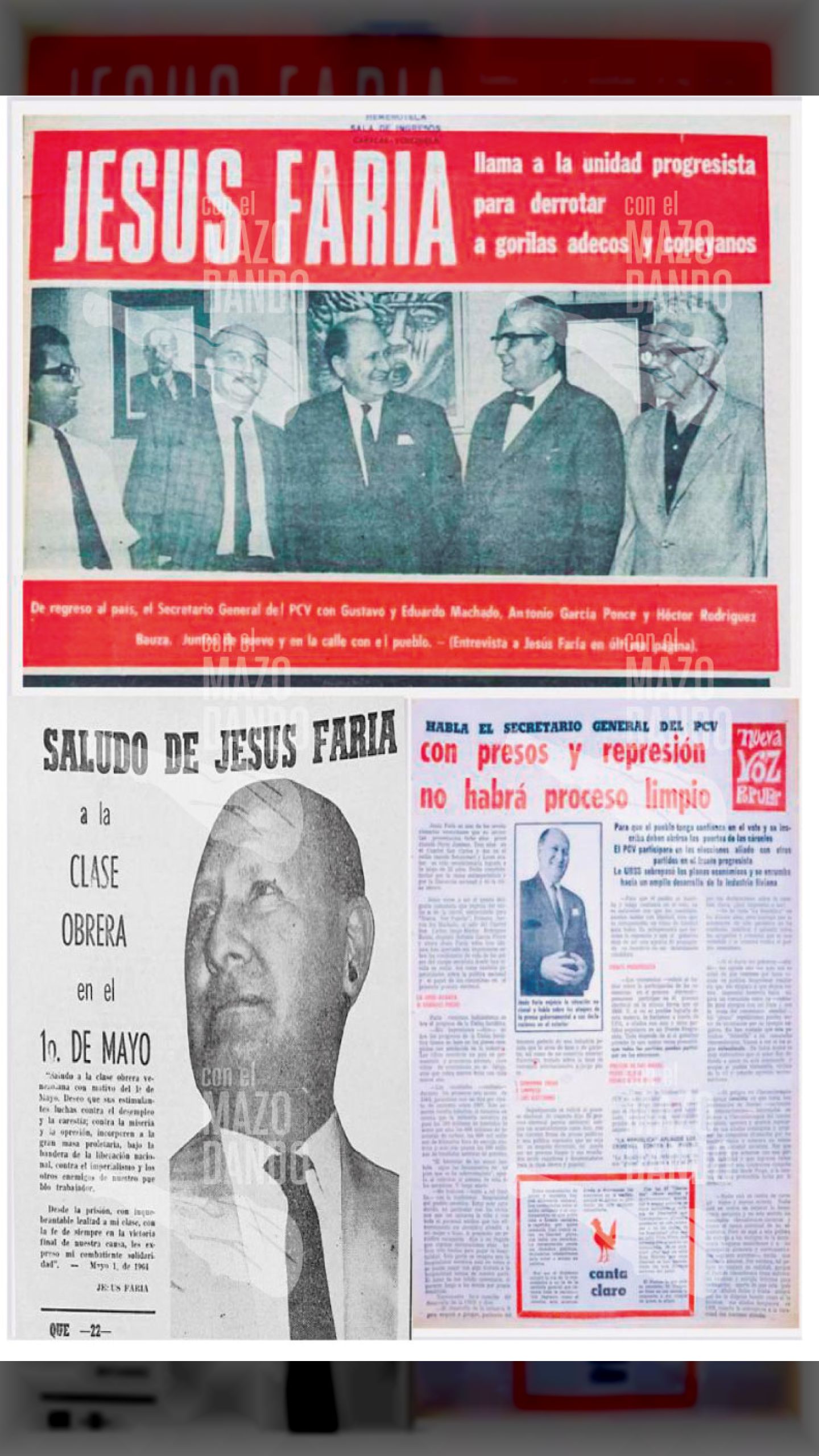
JESÚS FARÍAS DIES - PORTRAIT OF A REVOLUTIONARY
Published at: 29/01/2025 09:00 PM
(New Popular Voice, August 1968)
- On January 24, 1965, the legendary communist union leader Jesús Fária died.
- His life as a paid worker began in Mene de Mauroa, Falcón State, at the young age of 13.
- In 1924, he participated in the first Venezuelan oil strike in Mene Grande. The workers demanded the abolition of the work regime of seven days a week for 12 hours a day of work (7x12).
- Oil workers were subject to severe rules of surveillance and punishment. They were only admitted to the industry in exchange for two years of compulsory military service, with hunger wages.
- Workers were subject to unfair fines of up to six days of unpaid work. Humiliating posters were hung on the fined workers, announcing that they were dangerous thugs.
- In 1927, Jesús Fanía joined the Engineering Department of the Lago Oil Corporation.
- In 1929, he was forcibly recruited to take up arms against the invasion that Gustavo Machado organized to overthrow the regime of Juan Vicente Gómez.
- On December 31, 1935, he participated in the demonstrations for the death of the dictator, which culminated in a brutal repression.
- His life as a worker spent in the oil settlements of Cabimas and Lagunillas, where he participated in the consolidation of the first Union of Oil Workers and Employees (SOEP), at which point he joined the Communist Party of Venezuela (PCV) for life.
- He was self-taught, becoming literate on his own at the age of 27, beginning a series of important writings and speeches aimed at the badly abused working class and peasant class.
- In December 1937, he was elected as regional deputy and councilor for the Bolivar District of the state of Zulia.
- Since then, he has stood out as a union delegate in organizational activities and as their representative at international conferences and forums.
- On the night of November 13, 1939, the Lagunillas sublacustrine oil pipeline exploded. The transnational Gulf Oil Corporation, solely responsible for the accident, refused to close the flow valve to stop the flow of oil to the filling stations. This catastrophe caused more than 1,000 deaths.
- Jesús Fanía was able to verify that the company did not close the pipeline because he had an interest in evicting the town to exploit the underlying oil in that town.
- During the administration of General Marcos Pérez Jiménez, he was taken prisoner for leading the 1950 oil strike, remained incommunicado and relying on several prisons and concentration camps.
- In 1958 he was elected senator, spending three years in prison and two in exile under the governments of Rómulo Betancourt and Raúl Leoni.
- He was held in the San Carlos Barracks, in the area known as the Smoke Cave, until in 1966, due to his poor state of health, he was expelled from the country to Moscow, where he was received with the honors of an international hero.
- He was a member of the PCV for 60 years and was president of the PCV for 30 years.
Mazo News Team