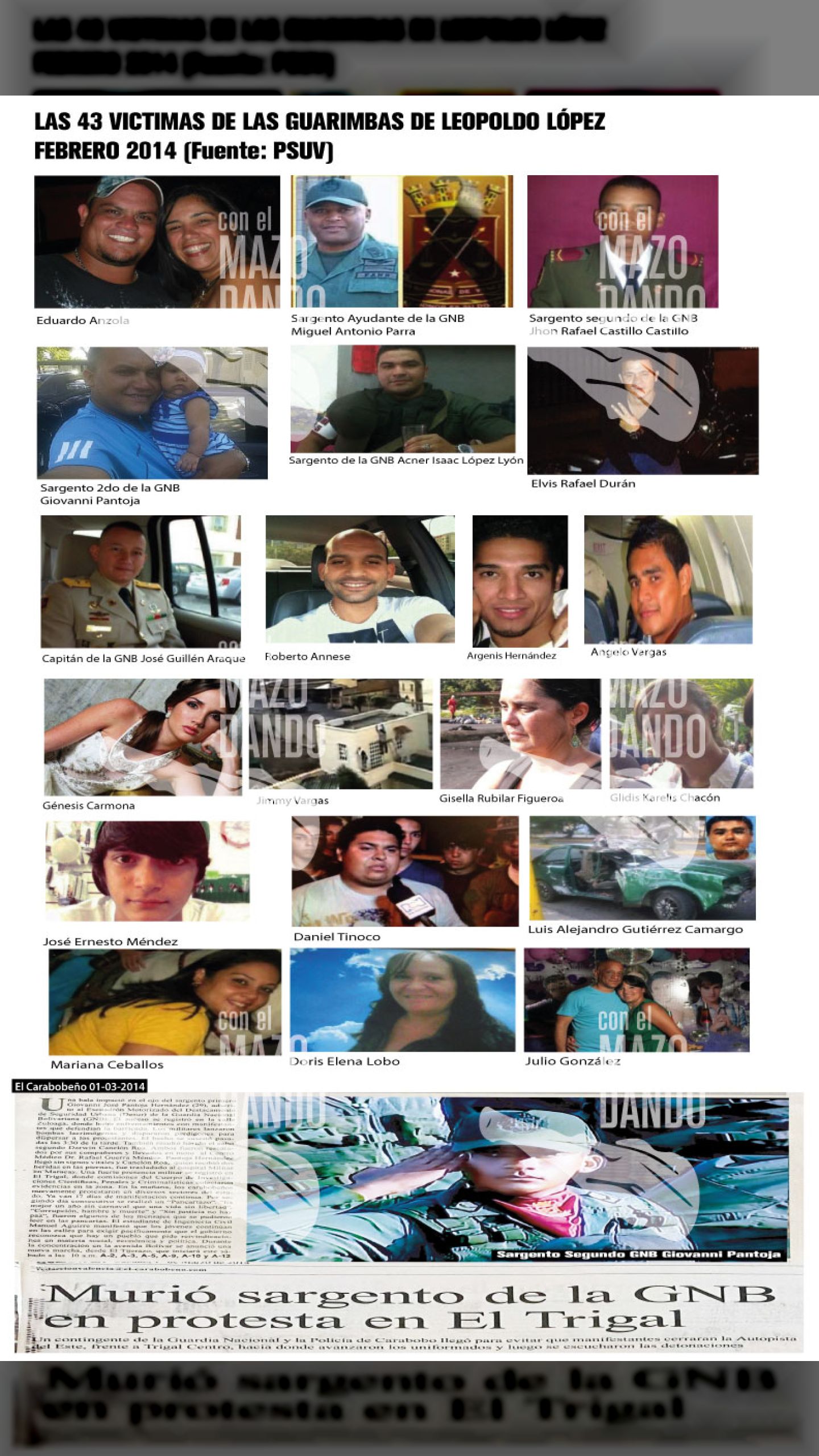
GUARIMBAS 2014 - THE 43 VICTIMS OF HATE AND FASCIST VIOLENCE
Published at: 26/02/2025 08:00 PM
(Correo del Orinoco, February 2014 and PSUV website)
- The more than 18,000 violent acts recorded from February to March 2014 left 43 people dead, economic losses in the order of 15 billion dollars and unquantifiable damage to the environment and public health.
- The most radical groups of the Venezuelan right showed their most anti-democratic face through the execution of numerous criminal acts and vandalism, including the attack on the Attorney General's Office, burning of health centers, schools, universities and headquarters of the United Socialist Party of Venezuela (PSUV).
- Intolerance against anyone who belonged to the popular sectors or was linked to the Revolution was the target of violence. This is the case of the children of Marlene Villegas, better known as “the Little Red Riding Hood”, who were savagely assaulted on Tuesday, April 14, in the municipality of Chacao, Caracas.
- The guarimbas, located in affluent or middle class areas governed by opposing mayors, kept their neighbors kidnapped in their homes or suffering a daily viacrucis to get to their jobs or study centers.
- The objective was to unleash ungovernability in the search for foreign intervention by the military forces of the North Atlantic Treaty Organization (NATO). In this sense, the media campaign that accompanied the violence, called “S.O.S Venezuela”, had a strong foreign projection, with the support of transnational communications companies.
- Most of the victims of hate and fascist violence were people who had little to do with the political conflict, many of them bystanders or citizens who, trying to mobilize or solve an emergency, were cruelly murdered. The victims of fascism were:
- Mariana Ceballos (32 years old), April 10. Valencia, Carabobo state. Opposition protester who, on March 14, was with a group of people at a barricade near the Shopping Center Shopping Center, in Prebo, in the capital of Carabobo, when she was hit by a person driving a Toyota Hilux van. The young woman spent almost a month in a coma, in the intensive care unit of a Carabobeña polyclinic.
- Roberto Annese (33 years old), March 29. Maracaibo, Zulia state. He died at 4:45am when he tried to manipulate a homemade mortar to throw explosives at security forces, while trying to defend a barricade. The explosive exploded in his chest, causing his death.
- Franklin Alberto Romero Moncada (44 years old). March 29th. San Cristóbal, Táchira state. He was also identified by the media as Luis Alberto Romero Moncada. He died electrocuted when, together with other people, he tried to tear down a billboard to be used on a barricade that had just been removed by the Bolivarian National Guard (GNB) and it touched a high-voltage cable, receiving a 13,000 volt shock that ended his life.
- Assistant Sergeant of the GNB Miguel Antonio Parra (42 years old). March 24th. Mérida, Mérida state. He was assassinated “on Las Américas Avenue by terrorist groups, led by fascist opposition leaders, who have been leading violent acts in the Andean region for weeks,” as explained by Governor Alexis Ramírez. He noted that Parra, along with other personnel, was lifting debris from a transport unit that was set on fire on Sunday, “when suddenly armed terrorist opposition groups (...) began shooting, mortally wounding the assistant sergeant of the GNB and injuring others present,” he reported. The regional president noted that Parra was transferred to the University Hospital of Los Andes and died minutes after his admission.
- Adriana Urquiola (28 years old). March 23. Los Nuevos Teques Urbanization, Guaicaipura municipality in Miranda state. I was a newlywed, five months pregnant and working as a sign language interpreter for the private television channel Venevisión. He was returning home late at night. Mayor Francisco Garcés explained that the young woman had not been able to reach her home “because the guarimbas prevented her passage”. This forced her to get out of the vehicle that was carrying her and walk home “because there was no passage in that sector of the Pan-American Highway”. The CICPC identified the alleged murderer as Jhonny Eduardo Bolívar Jiménez, who, interviewed by El Nacional, said that the death “was accidental”, since violent demonstrators at a barricade in the area would have shot him, and he, in response, shot his 9 mm Beretta into the air in a 50-degree trajectory; he stated that a bullet bounced off a pole and then hit the young Urquiola.
- Juan Orlando Labrador Castiblanco (39 years old). March 22. Mérida, Mérida state. He was a worker at a cooperative that offered contract services to CANTV and Movilnet. That day, a transport unit on the La Vuelta line was burned on Cardenal Quintero Avenue in Mérida, causing a confrontation between workers at the wheel, supported by inhabitants of popular sectors adjacent to the area, against violent demonstrators. “From the buildings (on Cardenal Quintero Avenue) they started shooting, and violent demonstrators could be seen carrying out terrorist attacks on the population, including a person with a rifle” and throwing niples from the roofs and the lower part of the buildings, said the governor of the entity, Alexis Martínez.
- Wilfredo Rey (31 years old). March 22, San Cristóbal, Táchira state. Public transport driver on the Barrio Sucre-Barrio Libertador line in the capital of Tachirense. According to private media, he died during surgery after being hit by a bullet in the head “when a group of irregulars shot several times in the vicinity of Barrio Sucre”.
- Argenis Hernández (26 years old). March 22, San Diego municipality, Carabobo state. Dr. Enrique Tejera Hospital City in Valencia died after being shot in the abdomen. According to the newspaper El Universal, the young man was injured on the afternoon of Friday, March 21, in the vicinity of the Tulipán housing estate, when he was with other demonstrators blocking the road that gives access to the Variante Bárbula-San Diego highway, and a motorized vehicle equipped with a firearm shot at those present.
- Second sergeant of the GNB Jhon Rafael Castillo Castillo (23 years old). March 19. San Cristóbal, Táchira state. The young man was part of the Urban Security Detachment of Táchira and was in the immediate vicinity of the National Experimental University of the Armed Forces (Unefa) in San Cristóbal, where a confrontation with terrorists took place; this university was the target of attacks by violent guarimberos days ago, who managed to burn it down and destroy it completely.
- GNB Captain José Guillén Araque. March 17. Maracay, Aragua state. He died early Monday morning after being hit by a bullet in the forehead while preventing a group of violent opponents from closing Casanova Godoy Avenue in the capital of Aragüeña with rubble. “There were more than 5 shooters who ambushed a commission of 5 unarmed men, who intended to protect the lives of the residents of the Calicanto and San Isidro housing estates,” explained government sources who highlighted him as number one in their promotion.
- GNB captain Ramzor Ernesto Bracho Bravo (36 years old). March 12, Mañongo, Naguanagua municipality, Carabobo state. Murdered on Wednesday afternoon while trying to impose public order at the Mañongo distributor on the Eastern Highway in Naguanagua, where there were strong guarimbas and confrontations with hooded men throughout that day. Through his account on the social network Twitter, the governor of the entity, Francisco Ameliach, reported that the cash died as a result of gunshots when confronted with “terrorist groups” that blocked traffic at the dealer.
- Jesús Enrique Acosta Matute (20 years old), March 12. Valencia, Carabobo state. Sixth-semester engineering student at the University of Carabobo, who was shot in the head in the La Isabelica housing estate. Family members say that he was killed by people on motorcycles, who were traveling from the Intercommunal La Isabelica-Plaza de Toros. Governor Ameliach reported that numerous snipers were present in that area shooting at civilians to generate a confrontation, which is why he earlier asked a revolutionary workers' march not to go through the place.
- Guillermo Sánchez (42 years old), March 12. Valencia, Carabobo state. He was hit by a bullet in the chest area, in sector 8 of La Isabelica when he was watching the demonstration and making a video of the action, according to his wife Lina Rodríguez. They also blamed motorized personnel, although Governor Ameliach had reported the threat of snipers present in that area, shooting at civilians to generate a confrontation.
- Ángelo Vargas, March 10. Guayana City, Bolivar State. He was killed late at night after leaving a meeting to discuss the resumption of classes at the National Experimental University of Guiana (UNEG). He was president of the Student Center for Administration and Accounting, a member of the Federation of University Centers and a revolutionary militant, who was part of the University Renewal Student Movement (MERU). Vargas was in the Colinas de Unare sector and three other people were allegedly injured in the incident, having been shot from a car. Vargas had participated in a tough debate with opposition students to resume classes at the UNEG and colleagues report that he had been threatened.
- Daniel Tinoco (24 years old), March 10. San Cristóbal, Táchira state. Student at the National Experimental University of Táchira (UNET) and opposition activist. He lost his life after being shot in the chest, according to Ángel Perdomo, director of the San Cristóbal Municipal Police, to private media. It was blamed on hooded men. Tinoco was located at the intersection of Carabobo Avenue and Ferrero Tamayo Avenue, a gathering place for opponents. The incident occurred after 10:00 p.m., and the victim was taken to the San Cristóbal Clinical Center.
- Gisella Rubilar Figueroa (47 years old), March 9. Mérida, Mérida state. He died after having spent 24 hours fighting for his life, after being shot in the face when, together with other Merida neighbors, he removed debris and garbage at an intersection of Los Próceres Avenue, in the Pie de Tiro sector in the city of Mérida. The event occurred between Saturday night and early Sunday morning. The gunshots came from hooded men from a nearby housing estate, determined to block an important access road.
- Glidis Karelis Chacon Benítez, March 7**. Prados del Este Highway (**southeast of Caracas), Baruta municipality in the state of Miranda. 25 years old. Detective of the Bolivarian National Intelligence Service (SEBIN). Members of SEBIN, in intelligence work, after having evidence that included videos and photographs, captured in flagrante delicto a dangerous citizen disturbing public order in Altamira, and took him away in an institution vehicle. Poli Chacao troops chased the SEBIN vehicle and opened fire on it on the Prados del Este highway, according to sources from the Internal Relations and Justice portfolio.
- José Gregorio Amaris Cantillo, March 6. Los Ruices (east of Caracas), Sucre municipality in Miranda state. He was part of a group of motorcyclists who were lifting and collecting debris from barricades in order to clear the roads, when, when they arrived in Los Ruices, residents of the place terrified by the presence of supposed groups, they threw blunt objects from the buildings at them. On Francisco de Miranda Avenue, someone shot him and killed him. Dr. Zaela Medina, a doctor at the Pérez de León Hospital, informed Venezolana de Televisión that the young Amalis Cantillo arrived with a gunshot wound in the right supraclavicular region, with apparent involvement of important blood vessels. “After 8 minutes of being in the surgical area, he had no vital signs,” he explained.
- GNB Acner Sergeant Isaac López Lyón, March 6. Los Ruices, Sucre municipality in the state of Miranda. After the death of the motorized José Gregorio Amaris Cantillo, the Bolivarian National Guard took over Los Ruices in the face of harassment from neighbors who threw rubble, bottles and stones from buildings at them. When taking María Auxiliadora Street (two blocks from the site where the motorist José Gregorio Amaris Cantillo died), someone activated a firearm from the buildings, seriously injuring López Lyón. He died in the private clinic where he was being treated. The commander of Regional Command number 5, Manuel Quevedo, informed Venezolana de Televisión that the murdered official was shot in the back from the bottom. By March 7, 12 people had been arrested in connection with these two deaths.
- Luis Alejandro Gutiérrez Camargo (26 years old). March 4, Rubio, Táchira state. The young student of the Libertador Experimental Pedagogical University (UPEL) abandoned a private celebration with some friends that day at 5 in the morning, in buildings in the central part of Rubio. The newspaper La Nación indicated that Gutiérrez “died instantly when he was catapulted out of the manned vehicle, when he tried to avoid some rocks that had been installed on a barricade on Las Américas Avenue, in Rubio.” The Minister of Communication and Information, Delcy Rodríguez, said that Gutiérrez Camargo “dies instantly when he collides with a barricade.”
- Deivis José Durán Useche (31 years old), March 3. Chacao municipality in Miranda state. He died after suffering a fractured skull on the night of Monday the 3rd when, on his way to his residence in Petare, he fell with his motorcycle into a sewer whose cover had been removed by opposition demonstrators on the Francisco Fajardo highway, a few meters from the Altamira dealer. The man was ejected from his motorcycle and hit the asphalt, suffering the severe injury that caused his death instantly. According to the version of their relatives, several demonstrators were holding guarimbas stages on the highway. The motorist who worked for the Cooperative Mototaxis line in La Castellana, did not notice that the sewers were without a lid and when he tried to brake it was too late.
- 2nd Sergeant of the GNB Giovanni Pantoja, February 28. Valencia, Carabobo state. He died when he was shot in one of his eyes in the vicinity of a violent demonstration in El Trigal, on the outskirts of Valencia.
- María Julieta Heredia (89 years old), February 27. Mother of the governor of Yaracuy, Julio León Heredia and of the deputy Néstor León Heredia. His death was due to a heart attack after a cacerolazo opposed to his home.” He was 89 years old, he was resting under strict medical care, and these groups arrived with insults, with attacks, with their saucepans,” added the national president after stating that “these events are collateral ravages of intolerance and hatred”.
- Eduardo Anzola (29 years old), February 25. Valencia, Carabobo state. He was riding his motorcycle along the Michelena Avenue crossing with Uslar in Valencia, when he hit a barricade made up of sticks, logs and stones, which he could not see because of the dark. At the time he died. He was an opposition member of the Venezuela Project party.
- Joan Quintero (33 years old), February 24. El Limón, Aragua state. He died under circumstances that were not fully clarified during a looting that occurred at the Super Leader supermarket, located in the area of El Limón, in Maracay. This fact is added to this list because it occurred after riots.
- Antonio José Valbuena Morales (32 years old), February 24. Maracaibo, Zulia state. He died of a shot in the head that he received on Monday 24 at 8:00 at night, in the Francisco de Miranda neighborhood, two blocks from the Galerías Shopping Center.” Antonio was coming in a motorized caravan that left the El Marite neighborhood. In all the streets, we were removing the rubble placed by the demonstrators to block them,” said a colleague from Valbuena. When the caravan approached the Francisco de Miranda neighborhood, a hooded person started shooting. “One of the bullets hit Antonio in the head,” the man said outside the forensic morgue. He was a father of a family with five young children and worked in the motorcycle taxi line “Los Duros de la Limpia”. According to Noticia Al Día, he had joined a group of about 80 motorcyclists who left western Maracaibo to clear some of the main roads before being shot.
- Jimmy Vargas (34 years old), February 24. San Cristóbal, Táchira state. He died of multiple injuries when he fell from a roof while preparing to defend his housing estate in the city of San Cristóbal, in the face of rumors that they would be harassed by civilians and police. Initially, it was reported that he fell from a gunshot wound, and the photo of his bleeding corpse was widely disseminated through media such as CNN, interviewing his mother. However, the autopsy ruled out that a gunshot hit him. Later, CNN en Español itself released a video that showed that he died accidentally: he fell when he lost his balance while hanging from the ceiling.
- Wilmer Juan Carballo Amaya (41 years old), February 24. Cagua, Aragua state. He was killed at the entrance of the La Fundación de Cagua housing estate. He was hit with a shot in the head allegedly coming from a group of people who were riding motorcycles. He was of Canarian origin. The results of the investigations are expected.
- Alejandro Márquez (43 years old), February 23. La Candelaria, Caracas. He died as a result of blows to the head; he fell to the floor while trying to flee from officials of the Bolivarian National Guard.
- Elvis Rafael Durán De La Rosa (29 years old), February 22. Horizonte, Sucre municipality, edo. Miranda. He was riding his motorcycle along Rómulo Gallegos Avenue in Caracas, when he hit a guaya (cable or metal wire) placed there by anti-Chavista terrorists.
- Geraldine Moreno Orozco (23 years old), February 22. Naguanagua, Carabobo state. According to reports from family members and witnesses, he died as a result of a shot of plastic pellets.
- **Doris Elena Lobo (**40 years old), February 20. Merida, edo. Mérida. He died as a result of serious injuries, when the motorcycle he was riding with one of his children crossed a barbed wire trap set up by opposition demonstrators. He had a cranial fracture and arrived at the hospital, but once there he suffered three heart attacks. “This was at 9:00 at night in the Santa Bárbara sector of Las Américas Avenue.
- Arturo Alexis Martínez (54 years old), February 20. Barquisimeto, that's it. Lara. Chavista militant, brother of PSUV national deputy Francisco Martínez. He died from a shot fired from a building while he was clearing the remains of a barricade to pass with his car.
- Julio González, February 19. Valencia, Carabobo state. He was a prosecutor in the Public Ministry. The newspaper Última Noticias explains that that day he was the prosecutor on duty in the state of Carabobo. He left his house at 11 in the evening to take a tour of the hospitals in Valencia. I was going to see the state of health of the victims of the protests in those days. First on their list was Genesis Carmona. He was in his van, on a descent, and he didn't see that there was garbage behind the barricade. The wheels of the car became entangled with debris and it went headlong into a tree. His death was instantaneous.
- Genesis Carmona (22 years old), February 19. Valencia, edo. Carabobo. Killed by a gunshot in the back while taking part in an opposition demonstration. Expertise determined that the shooting came from where the demonstrators accompanying the young woman were. “That young woman died from a bullet that came out of her own ranks,” said a statement from the Ministry of Interior and Justice.
- Luzmila Petit de Colina (70 years old), February 19. Caracas. Mother of Jean Francis Colina, one of the hosts of the Zurda Konducta program on the state public television channel VTV. Since February 12, he had a delicate medical condition. On February 18, at night, she suffered a rise in blood pressure that forced her to be transferred to a health care center. Along the way, a group of opposition demonstrators who were blocking the road in El Paraíso prevented the passage of the car in which the patient was being taken urgently. The death occurred in the morning hours of this Wednesday and, according to the doctors at the clinic, it occurred due to the time they took to attend to the emergency.
- José Ernesto Méndez (17 years old), February 17. Cumana, Sucre state. He died from severe head injuries after being hit by a private vehicle. According to the initial version, it occurred during an opposition protest that kept an avenue in the city cut off.
- Roberto Redman (28 years old), February 12th. Chacao municipality, Miranda state. Opposition protester, well known on social media by his pseudonym “EscualidoReload”. He was in the march that led to violent acts in the Attorney General's Office. Later, late at night, he participated in a violent protest in the municipality of Chacao. Witnesses attribute his death to armed civilians on motorcycles, who shot him and hit him in the head.
- Bassil Da Costa (24 years old), February 12. Carabobo Park, Caracas. Young worker who participated in the first opposition march to the Attorney General's Office, which began peacefully and turned violent at the doors of that entity. It falls on the same street as Juan Montoya, a few minutes apart and, as reported by the high government, because of shots fired by the same suspects.
- Juan Montoya (40 years old), February 12. Carabobo Park, Caracas. Leader of the popular January 23 zone, in western Caracas, identified with Chavism. He had met with President Nicolás Maduro at a public event in August 2013, acting as a spokesperson for social movements that surrendered their firearms, as part of government initiatives for the disarmament of the civilian population. He dies from a gunshot wound in circumstances investigated and attributed to officials of the Bolivarian Intelligence Service (SEBIN) who failed to comply with the quartering order. The officials involved have already been placed under the command of the Office of the Attorney General of the Republic. General Manuel Gregorio Bernal, who was director of SEBIN until then, was relieved of his position.
- Jorge Colina Tovar (24), PNB, was killed on the afternoon of May 07 by a sniper in the Los Palos Grandes residential area, while working during the early morning hours, to evict the camps, located in the municipality of Chacao.
Mazo News Team