BLACK FRIDAY Goodbye to the era of So cheap give me two! The Twilight of the Punto Fijo Pact
Published at: 19/02/2025 09:00 PM
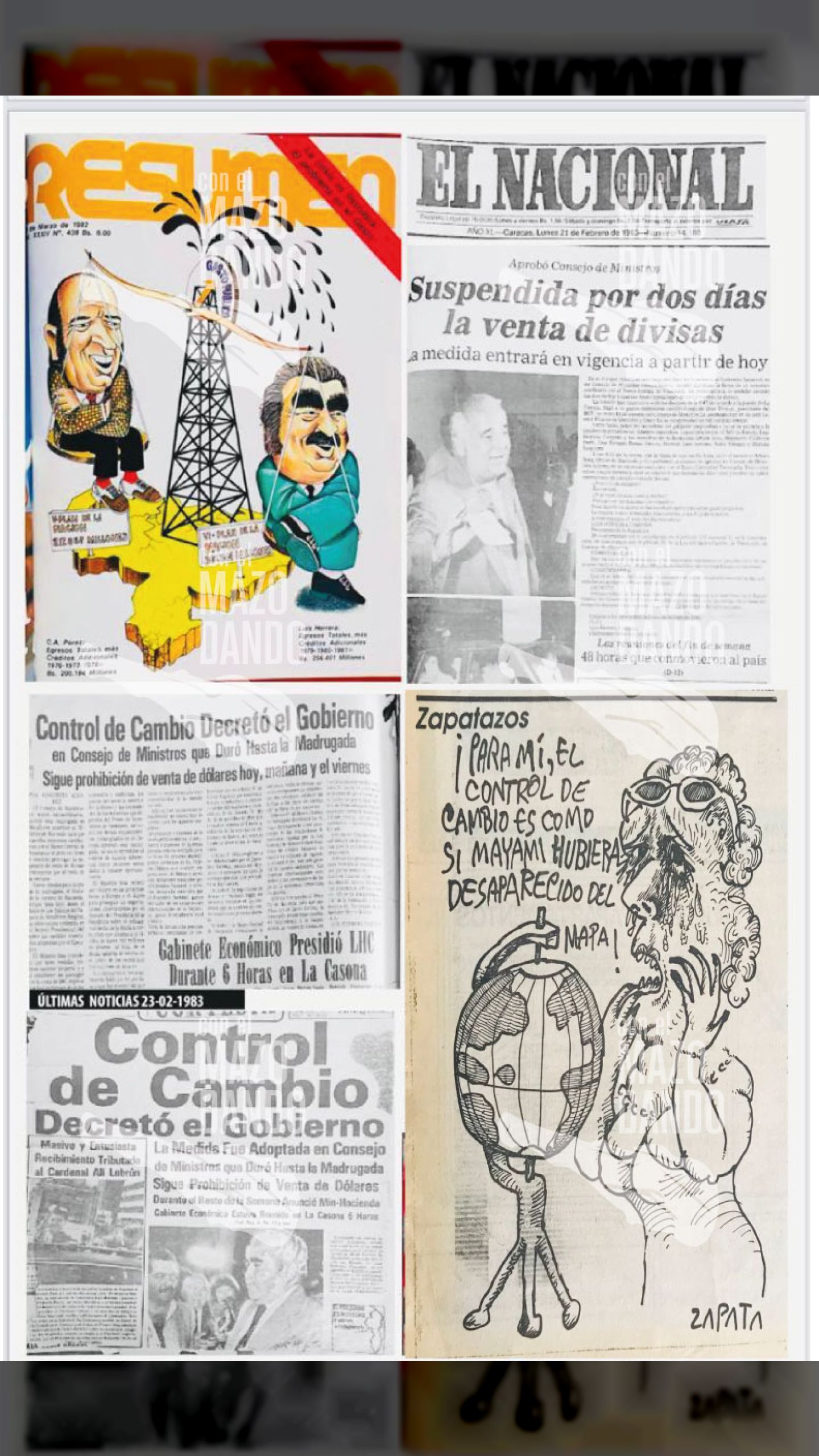
(Summary, El Nacional and Latest News, February 1983)
- The era of the unexpected increase in oil revenues by 300%, of government waste, of exorbitant fortunes and of waves of professional wastewater known as the “cheap give me two”, who invaded Miami to exercise recklessness and lawlessness for more than a decade, came to an end on Friday, February 18, 1983, when Venezuela, being one of the richest countries in the world, with no further explanation, woke up poorer and more indebted than ever.
- The parasitic bourgeoisie was dressed in mourning. In the months leading up to Black Friday, a billion-dollar stampede reduced our international reserves from 34 billion U$D to 700 million U$D. The BCV sold an average of 50 million U$D a day.
- In 1973, Carlos Andrés Pérez (CAP) received the presidential band from Rafael Caldera, with a foreign debt of 600 million U$D. At the end of his administration, that debt inexplicably increased to 37 billion U$D.
- As a result of the oil embargo in the Middle East, between 1973-1979, the Pérez government received the highest revenues in our history: 217.857 million U$D, of which it squandered 200,184 million U$D in two years (1976-1978).
- However, the Venezuelan economy was shackled to the payment of a debt, authorized by the government, in leonine and unpayable terms and conditions.
- Consequently, of every 100 U$D that Venezuela received for oil rent, 34 dollars were used to pay its foreign debt.
- Subsequently, during the administration of Luis Herrera Campins (1979-1984), a second oil boom tripled the revenues of the national treasury, without this serving to get Venezuela out of the impasse.
- Both presidents, following the guidelines of the Washington Consensus, indebted the country until they could, receiving loans under fraudulent conditions.
- Then there was an abrupt drop in oil prices, which prevented fiscal revenues from being sufficient to cover foreign debt commitments.
- International banks immediately demanded payment of 9 billion U$D, threatening to declare us in default. Thus, the exchange control disaster ensued as a desperate measure to prevent currency flight and the definitive bleeding of the economy.
BACKGROUND:
- Since 1938, the United States imposed, during the administration of General López Contreras, a Trade Reciprocity Agreement, through which Venezuela was forced to buy everything it consumed and to sell 100% of its oil production to Standard Oil (Exxon), Royal Dutch Shell and the Anglo Persian Oil Company (BP).
- This treaty only generated extraordinary benefits for a few companies, deepening social inequalities and recurrent outbreaks of popular protests.
- The imbalances caused in the parameters of the Venezuelan economy could only be sustained by the fiction of an apparently solid monetary sign that ranged between 3.30 (1936) and 4.30 (1983) bolivars per dollar.
- This strategy designed, from Washington, established an economic model that provided a comfortable living status to a minority sector of the population.
- Model based on a monoproductive economy, which displaced all other strategies that generate wealth and social welfare.
- For this reason, several Creole operators of our economy were loyal and lackeys:
- Banker Pedro Tinoco was one of the gurus of the Venezuelan economy who had been applying Washington's guidelines with the Commission for Administrative Reform for the State since 1964. He was also Pérez y Caldera's finance minister.
- Later, other operators subservient to the empire followed, such as Gumersindo Rodríguez, Carmelo Lauría, Miguel Rodríguez Alías Paquetico, Gustavo Rossen, Diego Arria, Ricardo Hausmann and Teodoro Petkoff, from Cordiplan.
Mazo News Team