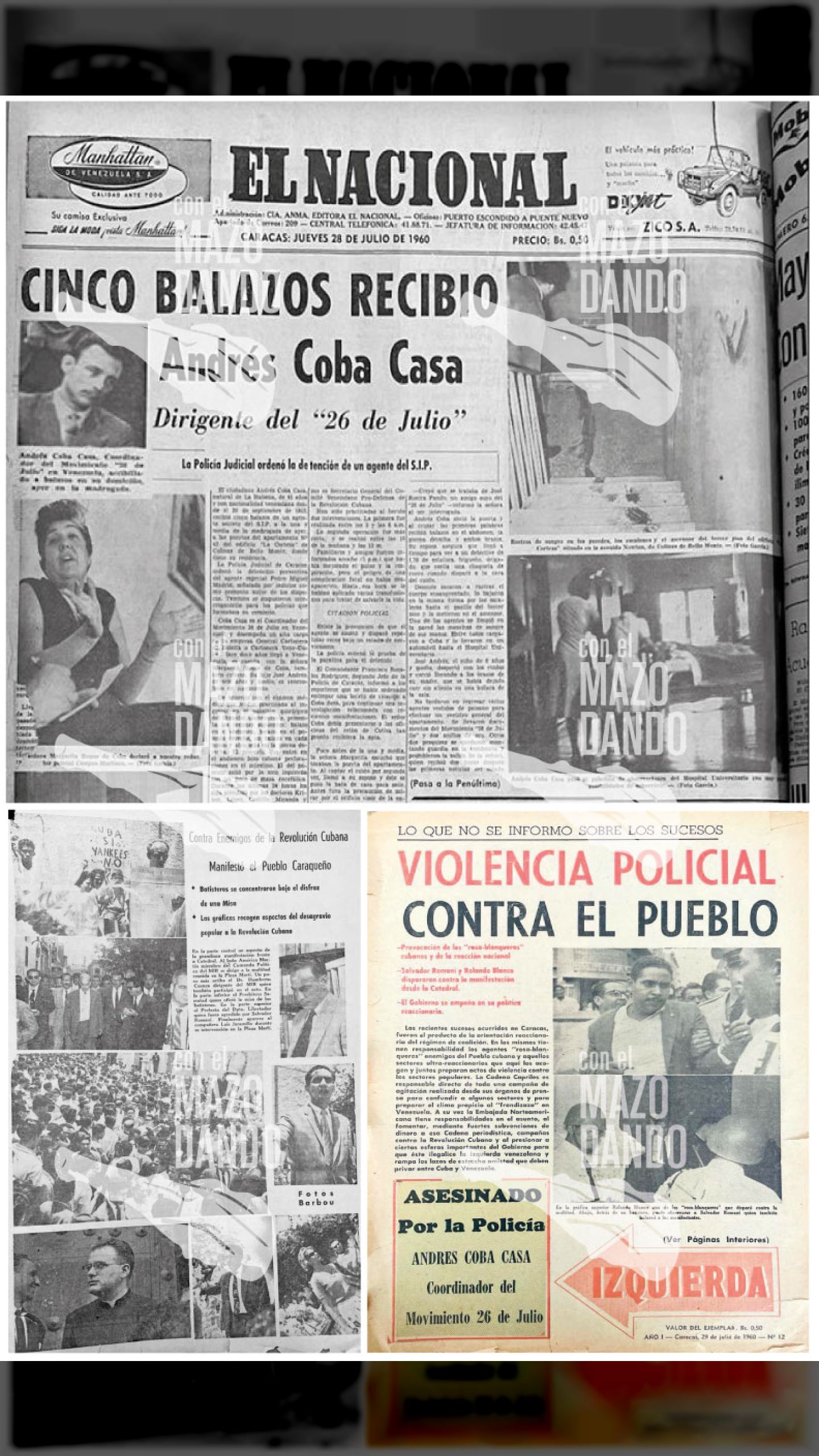
ANDRÉS COBA CASA - Leader of the 26th of July Movement - was assassinated in front of his family
Published at: 30/07/2025 09:00 PM
(El Nacional, July 28, 1960; Izquierda, July 29, 1960 — No. 12 and Ensartaos, December 12, 2018)
- In the early morning of July 27, 1960, Andrés Coba Casa, the national coordinator of the 26th of July Movement, was shot several times outside his home by a commission from the Police Intelligence Service (SIP). He was then Minister of Internal Relations, Carlos Andrés Pérez.
- Andrés Coba Casas was murdered in front of his wife and children. The leader was visited at his home by an SIP commission for a summons. It was 1:30 in the morning, when while trying to open the door, he received several bullets in the abdomen, right leg and both arms, and already on the ground, they finished him off. The police then dragged the body down the stairs to the corridor on the third floor and then to the elevator.
- The agent who presided over the police picket responded to the name of Pedro Miguel Madrid. The day after the crime, at a press conference, he stated that before going on a government mission to assassinate Coba Casa, his immediate superior boss, Rafael Sequera, told him: “don't worry, nothing will happen to you, the guarantees are suspended...”
- Neither the president of the Second Superior Criminal Court nor the Attorney General of the Republic found guilt in the police who committed such a horrendous crime. This is how democracy operated and the Constitution was “respected”.
- The citizen Coba Casa, in his capacity as coordinator of the 26th of July Movement, organized, the day before, a series of festivities and tributes to the Liberator Simon Bolivar, on the occasion of the seventh anniversary of the Assault on the Moncada Barracks. Insurrection led by Fidel Castro to overthrow the dictator Fulgencio Batista.
- Coba Casa organized several events in honor of the Father of the Fatherland, which were overshadowed by the shooting and attacks carried out by anti-Castro baptistery agents, from the headquarters of the Cathedral of Caracas. Criminal action that involved the collaboration, participation and protection of the parish priest of that church.
- Andrés Coba was a native of Havana, Cuba, and was nationalized as a Venezuelan on September 30, 1953, during the administration of General Marcos Pérez Jiménez. He lived in apartment No. 43 of the La Cortex Building, in the hills of Bello Monte, where he was massacred in the presence of his entire family.
THE CONTEXT:
- By then, Romulo Betancourt had already ordered the suspension of constitutional guarantees, in order to give free rein to his newly created General Police Directorate (DIGEPOL). Suspension that was first perpetuated for 511 days, and then until 1998 when Hugo Chávez came to power.
- The obvious intention was to give carte blanche to DIGEPOL and the Armed Forces Intelligence Service (SIFA) to violate the sacred compound of thousands of homes, schools, high schools and universities, without the need for a prior search warrant issued by a judicial authority.
- Since the end of 1959, the exiles of anti-Castro regime were operating de facto in Venezuela. The government subsidized them with all kinds of facilities, jobs, travel expenses and key positions in the police forces.
- From the United States, dozens of Cubans trained by the Central Intelligence Agency (CIA) and the Federal Bureau of Investigation (FBI) were sent to Venezuela to assume senior positions in DIGEPOL and SIFA.
- On the day of the crime, in Caracas, there were large demonstrations in favor of the Cuban Revolution. On all the lanterns in Plaza Bolívar, posters of Fidel Castro hung and thousands of people from Caracas brought floral offerings to the equestrian statue of the Liberator and honored the memory of José Martí.
- For their part, the widows of the Fulgencio Batista dictatorship, led by the gangster and murderer Salvador Romani, organized a mass in the Cathedral of Caracas, as a pretext for aggression.
- As part of the Eucharistic Solemnity, the cathedral was used as a trench to shoot from the inside at those outside who were celebrating July 26 in Plaza Bolívar.
Mazo News Team