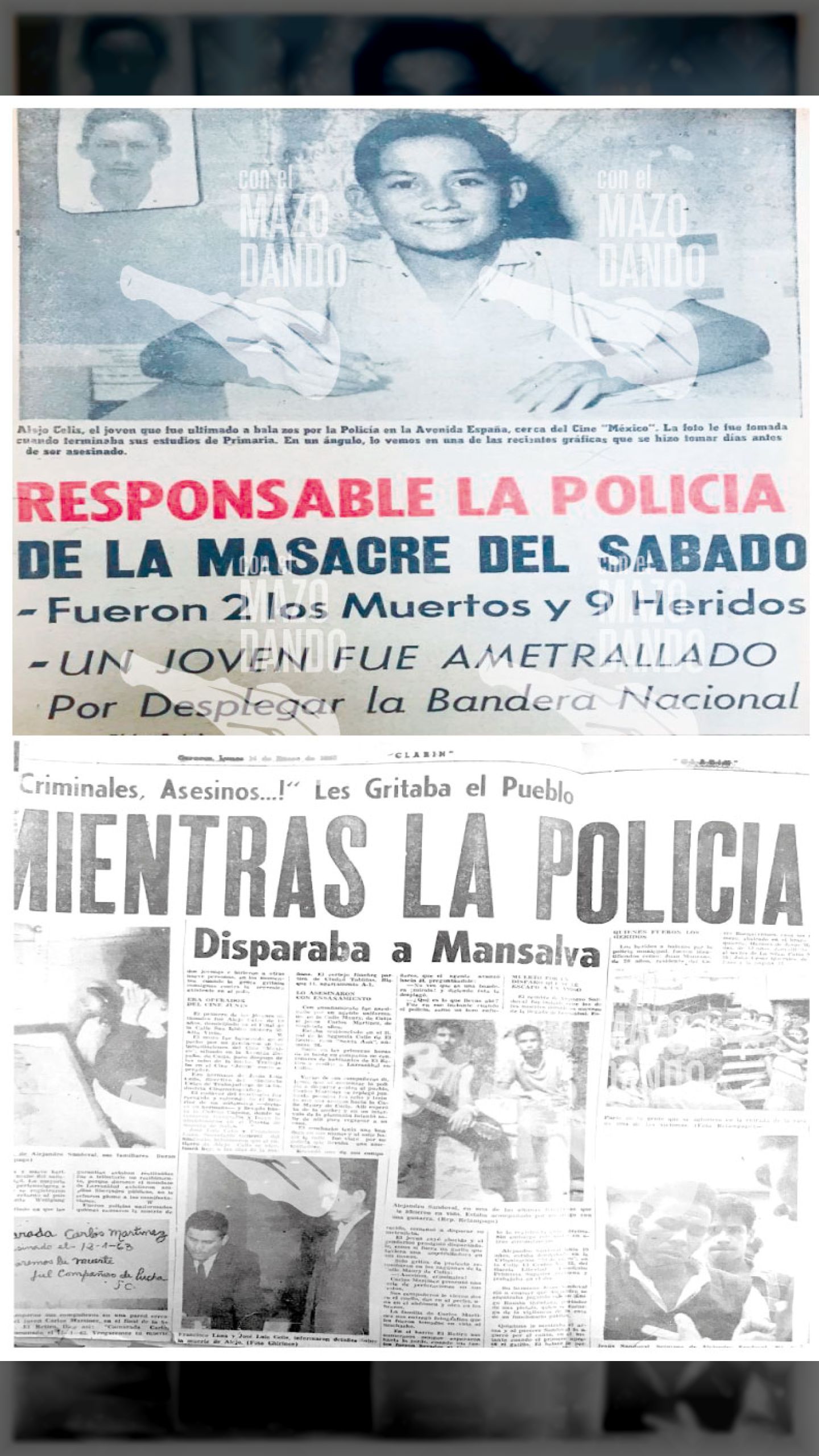
ALEJO CELIS AND CARLOS MARTÍNEZ MURDERED BY POLICE IN CATIA
Published at: 15/01/2025 09:00 PM
(Clarín, January 14, 1963)
- On Saturday, January 12, 1963, the young Alejo Celis and Carlos Martínez, aged 19 and 17, respectively, were massacred by agents of the Municipal Police of Caracas.
- That day, in the early hours of the afternoon, they went out, together with hundreds of inhabitants of Catia, to welcome Admiral Wolfang Larrazábal, who was returning to the country.
- In the midst of this popular reception, Alejo Celis was shot in the chest by an agent in the immediate vicinity of Cine México.
- That same afternoon, Carlos Martínez, a member of the Youth of the Communist Party of Venezuela, was intercepted on Maury Street in Catia by a police officer who, not content with shooting him once in the chest, strafed him to death.
- The student-workers, Alejo and Carlos, like many other demonstrators, were singing the National Anthem and waving the Venezuelan Flag at the time of the police attack.
CONTEXT:
- At that time, the policeman Carlos Andrés Pérez was Minister of Internal Relations, who unleashed the persecution against the Youth of the Communist Party, the left-wing militancy of the Democratic Republican Union (URD) and the supporters of Larrazábal.
- In that election year, newspapers such as La Extra, El Venezolano, Clarín, La Hora and QUÉ were raided and their printing presses looted by Digepol. In the city of Coro, the radio station Ondas de los Medanos was shut down.
- Its editors, José Vicente Rángel, José Herrera Oropeza, Orlando Araujo and Eleazar Díaz Rangel, were put behind bars for the crime of reporting on police excesses, shootings and murders committed against young people and leaders of non-outlawed parties who joined the wave of national discontent.
- Romulo Betancourt, to neutralize the popular support that the outlawed Communist Party of Venezuela (PCV) and Larrazábal had, unleashed the police minister and his Digepol thugs, managing to win the rejection of a large part of the electorate during his five-year period.
- During his administration, he aimed the weapons of the security forces against the Central University of Venezuela, technical schools, high schools and popular areas across the country.
- As a result, Wolfgang Larrazábal won 16 seats in the Chamber of Deputies and 4 in the Senate Chamber. In the 1958 elections, he had won second place with 903,479 votes.
- Larrazábal, as president, was recognized for the vertical position he maintained in favor of the popular protests that occurred due to the presence of Richard Nixon in Caracas, on May 13, 1958.
Mazo News Team